Coupon Forums vs Coupon Sites: Which Finds Codes That Work?
Coupon Forums vs Coupon Sites: Which Finds Codes That Work?

A coupon forum is a community: members post deals, vote on them and warn each other when something stops working. A coupon site is a catalog: it collects codes by store and lets you look one up when you are about to buy. The two answer different questions. Forums are good for finding out what is on sale. For a specific store and a specific cart, a catalog that checks its codes before publishing them gets you to a working discount faster, and that is how we build CouponHub: every code is verified before it goes live, across more than 3,000 stores.
TL;DR
- Forums rely on crowds. Members spot price drops and flag scams, but you have to read through threads and judge the posts yourself.
- Coupon sites rely on a catalog. You search by store, category or recency and get a code ready to copy.
- CouponHub checks the store, the code’s validity and the discount details before a code is published, so you spend less time on dead codes.
- Whichever source you use, treat a deal that looks too good to be true as a warning sign and confirm where the offer came from.
- Use a forum to learn what is happening in a sale season. Use a verified catalog when you already know the store you are buying from.
Table of Contents
- How coupon forums work
- How coupon sites work
- Forums vs coupon sites, side by side
- Why verification changes the experience
- Fake coupons: the risk on both kinds of source
- The people-power argument, and what it means for you
- How to use both without wasting time
- When a coupon site is the better first stop
- Try verified codes on CouponHub
- Our view: a code is only a saving if it works
- FAQ
- Sources
How coupon forums work
A forum is built on posts and replies. A member finds a price drop, a stackable offer or a code, writes it up, and others respond: “worked for me,” “expired this morning,” “cheaper at another store.” Ranking and voting systems push popular deals to the top.
This model has a long history. One archived academic list of deal sites from 2008 describes FatWallet and Slickdeals as forums where members post and discuss deals, while sites such as BensBargains and XPBargains listed deals and codes and were funded by link commissions and ads. The split between discussion boards and listing sites is as old as online couponing.
What forums do well:
- Speed on hot deals. A large community notices a mistake price or a limited-time promotion quickly.
- Context. You can read why a deal is good, whether it stacks with a sale, and what people paid last time.
- Scam spotting. A FatWallet representative told PCWorld that forum members are good at sniffing out scams and alerting others.
What that costs you is time. A thread can run to dozens of replies, the newest answer may contradict the top post, and a code that worked for one member may need a minimum spend or a first-order condition that you only discover at checkout.
How coupon sites work
A coupon site organizes offers by store. You go to the store’s page, see the codes, copy one and paste it in your basket. The strength is predictability: the same layout for every store, filters by category, and a clear sense of what is new.
The weakness of the model is quality. A catalog is only as useful as the work behind each listing. Sites that fill pages with scraped or unverified offers leave you to find out at checkout that a code is dead. PCWorld’s shopping columnist advised readers to skip sites with lots of broken links, expired deals and old content, which is a fair description of what a stale catalog looks like.
That is the gap we set out to close. CouponHub is a catalog with human-reviewed, verified promo codes for more than 3,000 online stores, sortable by store, category and recency, so the page you land on shows what is current rather than everything ever posted.
Forums vs coupon sites, side by side
| What matters to you | Coupon forum | Verified coupon site |
|---|---|---|
| Best use | Discovering deals and price drops | Finding a code for a store you have chosen |
| How offers appear | Members post them | Codes are published after review |
| Time to a usable code | Depends on reading threads | Open the store page and copy |
| Terms and conditions | Often buried in replies | Shown with the code |
| Browsing by category | Varies by board | Store, category and recency filters |
| Warnings about scams | Community reports | Checks before publication |
Neither is a replacement for the other in every moment. If you are hunting a deal on a laptop and have no store in mind, a forum thread shows you the field. Once you know where you are buying, the catalog is the shorter path.
Why verification changes the experience
Most frustration with coupon codes comes from the same few failures: the code expired, the code needs a minimum spend you did not know about, the code applies only to certain categories, or the code was never real. The gap between the headline and the threshold is where it stings.
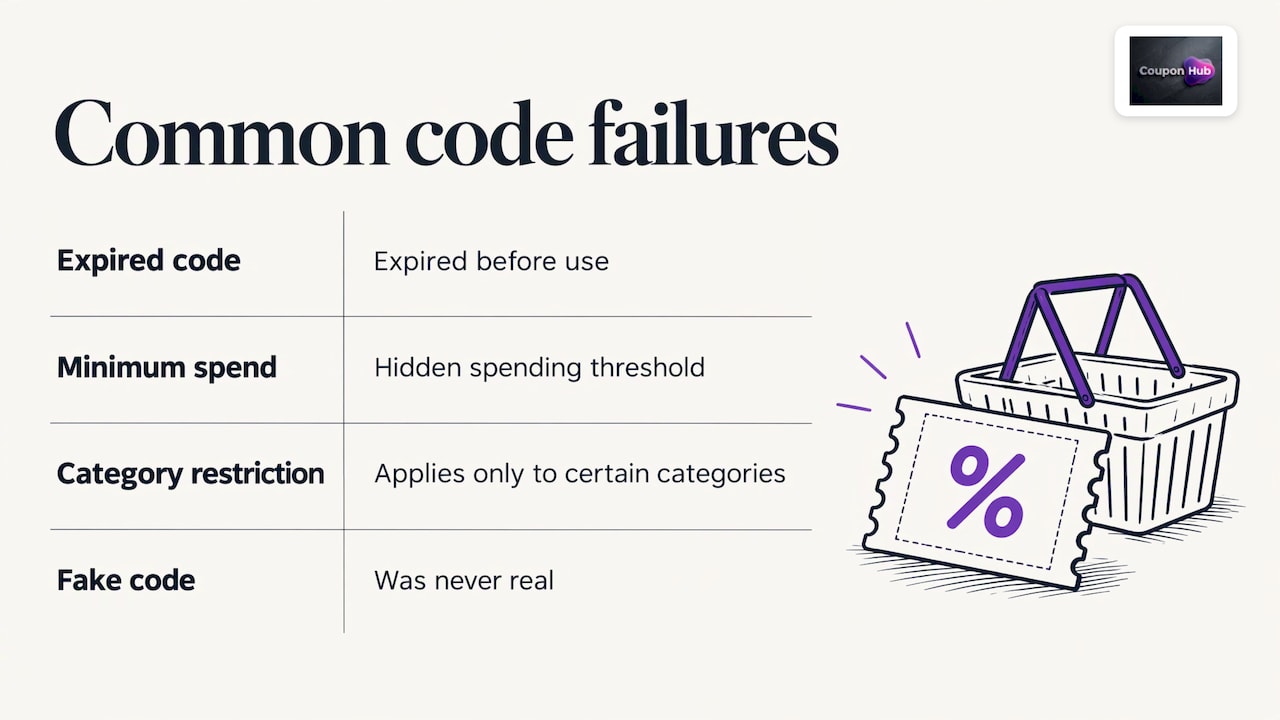
Our positioning is simple. CouponHub verifies promo codes before publication, including the store, the code’s validity and the discount details. We do not rely on scraped or unverified offers. That means when you open a store page, you are looking at codes that have already passed that review, with their terms attached.
If you want to see what a store page looks like in practice, the Bargainjunkie coupon codes page shows the layout: the code, the discount and the terms in one place.
Fake coupons: the risk on both kinds of source
Wherever you find a code, the Better Business Bureau has a warning worth knowing. Its October 2025 scam alert on fake coupons says counterfeit coupons often promise steep discounts, such as 80% off, using brands’ official logos. Its advice:
- Be skeptical of deals that seem too good to be true, especially ones near or above the retail price.
- Check the coupon’s source. When unsure, visit the company’s official website or call customer service.
- Hover over links in emails to inspect the URL before you click.
- Never hand over personal or payment information in exchange for a coupon.
- Search the offer together with the word “scam” if you doubt it.
The same logic applies to a forum post and to a catalog listing. A realistic percentage, a named store and visible terms are signs of a normal promotion. A reputable coupon site should ask for no more than an email address to create an account, as PCWorld’s columnist put it. If a site wants more, leave.
For a deeper walk through the checks before you pay, see our guide on how to check coupon validity before checkout.
The people-power argument, and what it means for you
The case for crowds is real. In a 2008 ABC7 San Francisco report, the co-founders of a large coupon site credited its growth to “the whole people power thing,” saying that even a staff of 50 could not produce the volume of content its community did. The same report noted that some merchants, J.Crew among them, asked for user-contributed coupons to be removed.
Two lessons follow for a shopper. First, community volume is a strength for discovery: the more people watching, the more deals surface. Second, volume and accuracy are different things. Merchants control which codes they honor, and a code posted by a stranger may be one the merchant never intended to be public.
That is why we put review ahead of volume. A smaller set of codes you can trust at checkout is worth more than a long list you have to test one by one.
How to use both without wasting time
You do not have to pick a side for life. A routine that works for most online shoppers:
- Decide what you are buying. If you have no store in mind, browse a deal forum for ideas and price context. During big sale periods, PCWorld’s Black Friday guide suggests checking Slickdeals’ crowdsourced forum for spotted prices.
- Once you pick a store, go to its verified code page. On CouponHub, open the store page or use the category filter, then sort by recency.
- Read the terms before you copy. Look for the minimum spend, the product categories covered, and whether the code is for new customers only.
- Apply the code in your basket before entering payment details. Our walkthrough on how to apply promo codes at checkout, online and in apps covers the common places the box hides.
- Sign up for the retailer’s own emails if you shop there often. PCWorld notes that some codes, such as Newegg’s subscriber-only ones, do not appear on deal or coupon sites.
If a code fails, it is usually one of a handful of causes: expired, below the minimum spend, excluded items in the cart, or a single-use limit. Our page on expired promo codes and whether they can still work explains each one.
When a coupon site is the better first stop
Choose a verified catalog first when:
- You already know the store and want the best current code.
- You are buying in a category you shop often, such as fashion, beauty or technology, and want to compare stores.
- You want to see recent additions without reading a thread.
- You want the terms next to the code, not in the fourth reply of a discussion.
For wider reading, our deal forums comparison covers the forum side in more depth, and the online couponing guide lays out the whole routine from first search to final basket. If you are after a particular store, how to find store coupons that work shows how to narrow the search.
Try verified codes on CouponHub
CouponHub brings together codes for more than 3,000 online stores, each checked before publication for the store, validity and discount details. Browse by store, category or recency, and compare stores before you buy. For a quick start, open the CouponHub home page and search the store in your basket.

Between shopping sessions, you can also play the free coupon-themed games in the CouponHub games section.
Our view: a code is only a saving if it works
We started CouponHub because of a feeling every online shopper knows: you find a code, you paste it, and the basket says it is invalid. Forums are a great place to talk about deals. But when you are at checkout, you do not want a discussion. You want the code and its terms.
That is why we verify before we publish. We check the store, whether the code is valid and what the discount really is, then we put it on a page you can sort by store, category and recency. Our approach is to let reviewed codes lead and let you spend your time on the purchase, not on testing a list.
Across more than 3,000 stores, the goal is the same: accurate, dependable codes you can trust. The community model proved that people love sharing deals. We think the next step is making sure what is shared holds up when you click.
CouponHub Team
FAQ
Are coupon forums better than coupon websites?
They are better at different things. Forums are strong for discovering deals and reading community feedback, while a verified coupon site is faster when you already know the store. Using a forum for ideas and a catalog like CouponHub for the final code covers both.
Why do some coupon codes not work?
The usual causes are an expired date, a minimum spend, excluded products, or a code limited to new customers. Some codes were never valid at all. Reviewing the terms before you apply a code, and choosing a source that verifies codes before publication, removes most of these surprises.
How can I tell a fake coupon from a real one?
The Better Business Bureau advises being skeptical of very steep discounts, checking the coupon’s source, avoiding links you have not inspected, and never giving personal or payment information to get a coupon. Searching the offer plus the word “scam” is a quick extra check.
Do I need an account to use a coupon site?
Not necessarily. PCWorld’s shopping columnist noted that a reputable coupon site should ask for no more than an email address to create an account. On CouponHub you can browse store pages and codes by store, category or recency.
Can I use a forum and a coupon site together?
Yes. Look to a forum for deal ideas and price context during busy sales, then open the store’s page on CouponHub for a verified code and its terms before you pay.
Sources
- ListSitesOfferingDealInformation, Law and Contemporary Society TWiki
- Secrets of online shopping discounts, ABC7 San Francisco
- Skeptical Shopper: Using Online Coupons? Watch for Scams, PCWorld
- BBB Scam Alert: Watch out for fake coupons on social media
- Black Friday: Everything you need to know, PCWorld