Referral Codes vs Coupons: What Each One Does at Checkout
Referral Codes vs Coupons: What Each One Does at Checkout

A referral code credits another person when you use it. A coupon takes money off your own order and credits no one. That one difference decides who gets rewarded, how large the discount tends to be, what conditions apply and whether you can combine it with other offers. Both can save you real money, but they behave differently at checkout, and mixing them up is how shoppers end up with a rejected code and a full-price basket.
This guide explains the difference in plain terms, shows where each type tends to win, and gives you a short routine for checking terms before you pay. At CouponHub we verify every code before it is published, so the coupon side of the comparison is the one we can help you with directly.
TL;DR
- A referral code belongs to a specific customer. Using it usually rewards both you and that person, often as a new-customer offer or account credit.
- A coupon or promo code is issued by the store for anyone to use. It cuts your order total and rewards no one else.
- The functions overlap: a referral code can also give you a discount, so check what the code does, not just what it is called.
- Stacking rules are set by each store. Never assume a referral code and a coupon can be used on the same order.
- Before paying, confirm the expected discount shows in your order total, and read the minimum spend, expiry and exclusions.
Table of Contents
- The core difference: who the code points to
- How referral codes work
- How coupon and promo codes work
- Referral link vs referral code
- Which one saves more?
- Can you use a referral code and a coupon together?
- A five-point check before you pay
- When a code does not work
- Where we stand
- Find verified coupons for the store you are shopping
- FAQ
- Sources
The core difference: who the code points to
The cleanest test is to ask whose account gets credited. If entering the code credits another person’s account, it is a referral code. If it only takes money off your own order, it is a coupon.
Shopify’s guide to referral codes explains the mechanics: a referral code identifies a specific customer or partner, which lets the business attribute a new customer to whoever sent them. A generic promotion code does not identify an individual referrer. So a code like SUMMER25 gives everyone the same discount and never tracks who brought you, while a code tied to a named customer credits that customer when you buy.
The same guide notes that the two can overlap, because a referral code can also provide a discount. That is why a store’s sign-up page might say “get $20 off with a friend’s code” while a coupon page says “20% off sitewide”. Both lower your price, but only one of them sends a reward to someone else.
Referral code vs coupon at a glance
| Referral code | Coupon or promo code | |
|---|---|---|
| Who owns it | A specific customer or partner | The store, for anyone |
| Who is rewarded | Usually the sender and the new customer | Only you, through a lower price |
| Typical reward | Account credit, cash bonus, or new-customer discount | Percentage off, dollar amount off, free shipping |
| Who can use it | Often new customers only | Often public, sometimes limited to one customer |
| When the reward arrives | Sometimes after your first order is completed | At checkout, in the order total |
| Where you find it | From a friend, a store’s refer-a-friend page, or an app | Store promotions, newsletters, verified code listings |
The table shows tendencies, not laws. Each store writes its own terms, and those terms always win.
How referral codes work
A referral program is a store’s way of letting existing customers bring in new ones. PayPal’s U.S. guide to referral links and rewards describes the pattern: when someone uses a referral link or code to buy or sign up, both the sender and the recipient often receive a reward, such as a discount, credit or cash bonus.
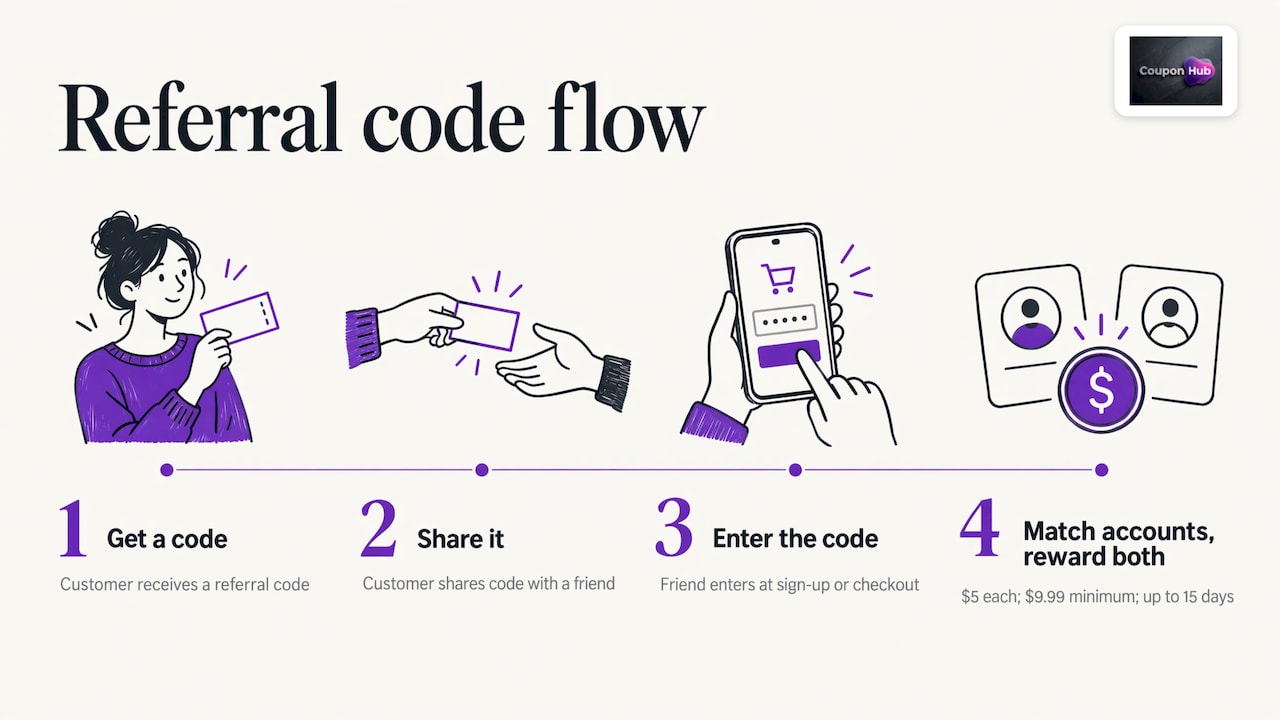
In practice the flow has four steps. A customer gets a code, shares it, a friend enters it at sign-up or checkout, and the business matches the two accounts and pays out once the conditions are met. Dynadot’s explainer gives a concrete case: both sides receive a $5 credit after the friend’s first order of $9.99 or more, and the credit can take up to 15 days to appear. The friend also needed at least $1.99 of account spending in the prior 365 days, which shows how specific the conditions can get.
The conditions that trip people up
Referral rewards tend to carry more conditions than a plain coupon, because the store is paying two people and wants to confirm the referral is genuine. Here are real examples from stores’ own published terms:
- Waiting periods. Cricket Wireless says customers with an eligible online account and 30 days of active service can earn up to $250 per year across 10 referrals per calendar year. After 60 days of active service both people receive $25 account credits, and the friend must redeem their 13-character code within 30 days of getting it.
- Order minimums and one-time use. Under Instacart’s referral terms, each referral coupon may be used on one order of $35 or more with one retailer, and the referrer is paid only after that order is fulfilled.
- Household limits. The same Instacart terms say codes cannot be used retroactively and referrals cannot be made to members of the same household or related accounts.
- Entry timing. Yotpo’s guide notes that companies differ on when a referral must be entered: some require it at sign-up, others allow it through the first purchase, and entering it late may lose the credit.
The lesson: with a referral code, the moment you enter it matters as much as the code itself. If you already have an account or have already placed an order, many programs will not accept it at all.
How coupon and promo codes work
A coupon code is simpler. The store publishes it, and it applies a promotion to your order. Webopedia’s guide explains that checkout systems validate a code against active dates, customer eligibility, minimum spend, product scope, usage limits and stacking rules before applying the discount. Public codes can be used by anyone, while single-use codes can be tied to one customer and expire after one order.
That last point is where the line between coupon and referral blurs. A one-time code sent to your email is still a coupon, because it rewards only you. A code that carries a friend’s name and pays them is a referral code.
If you want a deeper look at how those two labels differ in everyday shopping, our guide on promo codes vs coupons covers the naming at checkout.
What a coupon does not cover
Stores often limit what a code touches. Back Market’s U.S. help page, for example, says its promo codes do not cover taxes, protection plans, additional shipping costs or its quality-assurance fee, and permits only one promo code per order. A “20% off” headline can therefore shrink once the order total is built. The gap between the headline and the threshold is where it stings, so it pays to read the exclusions. Our coupon fine print guide translates the common wording.
Referral link vs referral code
People also mix up referral links and referral codes. They are two ways to deliver the same thing. A referral link is a URL with the code built in, so clicking it can apply or track the referral without typing anything. A code is entered by hand at checkout or sign-up. Shopify’s guide says brands may offer both.
Practical consequences:
- If you were given a link, open it in the browser where you will actually buy, and sign up or check out from that same session so the referral is not lost.
- If you were given a code, look for the field labeled for referrals or invite codes. It is often separate from the promo code box.
- If a store gives you a referral discount as an account credit rather than a code, it usually sits in your account balance instead of appearing in the cart.
Which one saves more?
There is no universal winner. It depends on who you are to the store and what you are buying.
Referral codes tend to win when you are new to a store. Many programs reward new customers specifically, and the welcome offer can be a flat credit rather than a percentage. A flat credit can beat a percentage on a small order.
Coupons tend to win when you are a returning customer or when the order is large. Most referral offers exclude existing accounts, while a public coupon works for anyone.
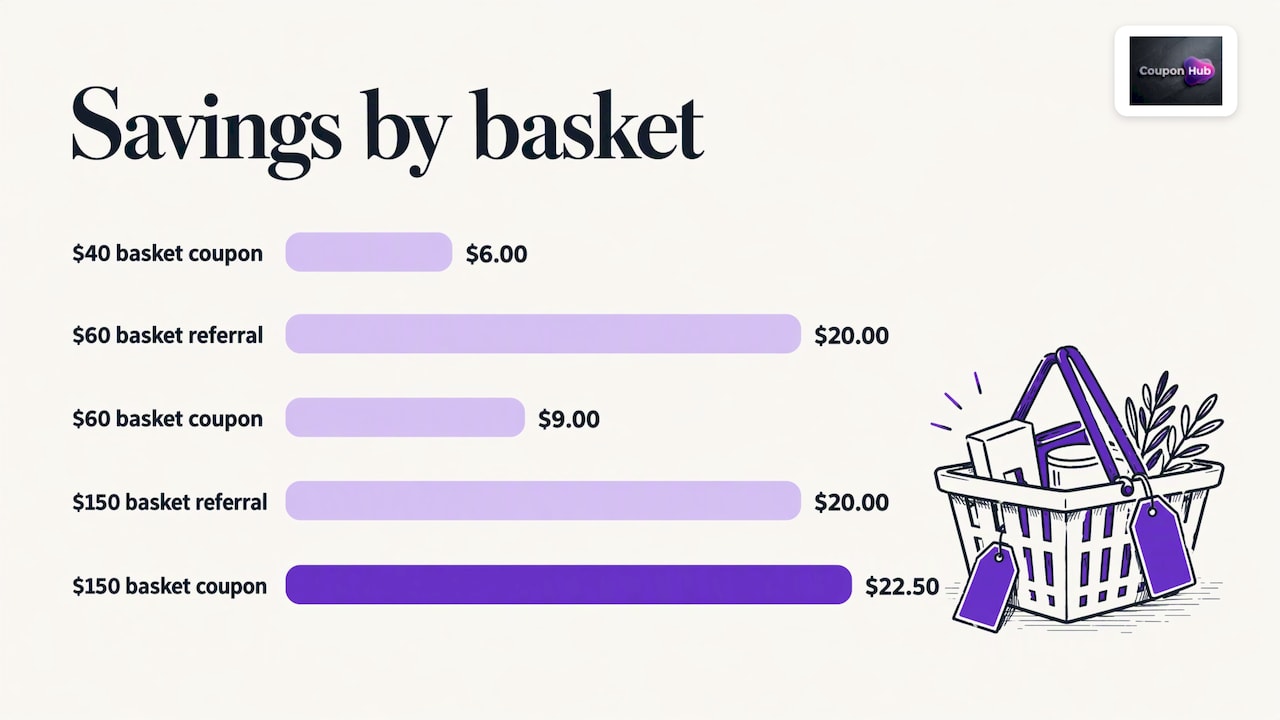
Here is a hypothetical example, with made-up numbers, to show how to compare. Say a store offers a $20 new-customer referral credit that needs a $50 minimum, and a separate public coupon for 15% off with no minimum.
| Basket | Referral credit ($20 off, $50 minimum) | Coupon (15% off) | Better option |
|---|---|---|---|
| $40 | Not eligible, $0 | $6.00 | Coupon |
| $60 | $20.00 | $9.00 | Referral |
| $150 | $20.00 | $22.50 | Coupon |
The crossover point is the flat amount divided by the percentage: $20 divided by 0.15 is about $133. Below that basket size and above the minimum, the flat credit wins. Above it, the percentage wins. Run the same arithmetic with any pair of offers you are considering.
Can you use a referral code and a coupon together?
Sometimes, but only when the store says so. GlassesUSA’s help page says its checkout permits one standard promotional code, yet it allows its Friend Referral Code alongside a standard promotional coupon. That is a store-specific exception, not a rule you can carry to other shops. Back Market, by contrast, limits an order to one promo code.
So treat stacking as a question to answer from the store’s own terms:
- Look for wording such as “cannot be combined with other offers” or “one code per order”.
- If the referral field and the promo field are separate boxes at checkout, the store may be built to accept both, but only the terms confirm it.
- If the terms are silent, do not count on stacking. Apply the larger saving first and see what the order total does.
For how combinations work across stores, see our guide to coupon stacking online, and if you also earn cash back, cashback stacking shows how to layer rewards on one purchase.
A five-point check before you pay
Whichever type of code you use, the same routine protects the saving. Webopedia’s guide recommends reading the offer terms for active dates, eligible customers, minimum spend, eligible products and exclusions, usage limits, location or channel limits, and whether other offers may be combined. Then:
- Check the type. Does it credit you now, or credit an account later?
- Check eligibility. New customers only? One use per household?
- Check the threshold. Is there a minimum spend, and does your basket still clear it after items are removed?
- Check the scope. Taxes, shipping and fees are often excluded.
- Check the total. Enter the code in the cart and confirm the expected discount appears in the order total before you pay. If you need a refresher on where to enter each code, see how to apply promo codes at checkout.
When a code does not work
A rejected code is usually a terms problem, not a broken code. Webopedia suggests checking the expiration date, order minimum, excluded items, account eligibility, use limits, channel or country restrictions and typing accuracy. If none of that explains it, contact the retailer’s customer service.
For referral codes, add two checks: whether you are counted as a new customer, and whether you entered the code at the point the store requires. Location can matter too, which our piece on regional restrictions on coupons explains.
Where we stand
Shoppers rarely get burned by the discount itself. They get burned by the gap between what a code is called and what its terms allow. A referral code that needs a new account, a coupon that needs a $75 basket, a promo that excludes the item you wanted: each one looks like savings until the order total says otherwise.
That is why we verify every code before we publish it, including the store, whether the code is valid and the discount details. We list codes for more than 3,000 online stores and let you sort them by store, category and recency, so you can compare a store’s public offers before deciding whether a friend’s referral code is worth chasing.
Our view is simple: a trustworthy code is one you can check against its terms, and a good deal is one that still holds up in the cart. We would rather you save $10 you can count on than $30 you cannot.
CouponHub Team
Find verified coupons for the store you are shopping
When you want the public-offer side of the comparison, start with CouponHub. Every code is verified before publication, and each listing shows its terms, so you can see the discount, the conditions and how recent it is before you click through to the store. Browse by store or category on CouponHub, or read our guide to finding promo codes that actually work.

If you shop at a particular store often, our store coupon guide shows how to narrow the list to that store’s current offers.
FAQ
Is a referral code the same as a promo code?
Not quite. A promo code is a store-wide marketing code that anyone can use, and it rewards only the buyer. A referral code belongs to a specific customer and credits that person when you use it. The two overlap because many referral codes also give the new customer a discount.
Do I need to be a new customer to use a referral code?
Usually, yes. Most programs reward new customers, and some check that you are not in the same household as the referrer. Instacart’s terms, for instance, bar referrals between members of the same household or related accounts. Read the program’s terms before you sign up.
Can I use a referral code and a coupon on the same order?
Only if the store allows it. GlassesUSA permits its Friend Referral Code alongside a standard promotional coupon, while Back Market allows one promo code per order. Check the store’s terms, and see our stacking guide for how different stores handle it.
Why did my referral credit not show up right away?
Many stores pay referral rewards after a condition is met, such as the friend’s first order being fulfilled or a set number of days of active service. Dynadot says its credit can take up to 15 days, and Cricket pays after 60 days of active service. Look for the payout timing in the program terms.
Sources
- Referral Codes: What They Are and How They Work, Shopify
- Referral Links and Rewards, Explained, PayPal US
- What Is a Referral Code and How Does It Work?, Dynadot
- Refer A Friend Program, Cricket Wireless
- Referral terms, Instacart Help Center
- What Is a Referral Code? Meaning, Examples and How It Works, Yotpo
- What Is a Coupon Code? How They Work and Where to Find Them, Webopedia
- How do Back Market promo codes work?, Back Market Help
- Can I use more than one coupon code?, GlassesUSA Help