Storewide vs Category Coupons: What Each Covers and How to Pick
Storewide vs Category Coupons: What Each Covers and How to Pick

A storewide coupon takes money off your whole order, while a category coupon only touches items in one department or product group. That single difference decides how much you save, which exclusions bite, and whether a code you copied will actually work at checkout. Below, we explain how each type behaves, how stacking works, and a quick way to compare final prices before you pay. Every code we publish at CouponHub is verified before it goes live, so the terms you read here are the terms you can check against a listing.
TL;DR
- A storewide coupon applies to the whole transaction. A category coupon applies only to qualifying items in a named department.
- Both usually carry a minimum spend, and the threshold is often measured before tax and after other discounts.
- Exclusions (clearance, gift cards, certain brands) are where most failed codes go wrong. Read them before you fill your basket.
- Retailers set their own stacking rules. Many allow one storewide offer per order, so compare the final total rather than the headline percentage.
- Pick the coupon with the lowest final price, not the biggest number on the banner.
Table of Contents
- The core difference in plain terms
- Why retailers use both
- What a storewide coupon really covers
- What a category coupon really covers
- Can you stack them?
- How to compare two coupons before you pay
- Reasons a storewide or category code fails
- Which one should you choose?
- Where CouponHub fits
- Our view
- FAQ
- Sources
The core difference in plain terms
Think of scope. A storewide coupon has the widest scope a retailer can offer: 15% off your order, or $10 off $50, with the discount calculated on everything eligible in the basket. A category coupon narrows the scope: $5 off $15 of personal care, or 20% off shoes.
Target’s coupon policy draws the line clearly. A storewide offer applies to the whole transaction, and only one storewide offer per guest can be used per transaction. A category or department offer applies to qualifying items within that department, and only one category-level offer per guest can be applied to any individual item. If you redeem more than one category or storewide coupon, you must meet the purchase requirement for each one separately.
Here is how the two compare side by side:
| Storewide coupon | Category coupon | |
|---|---|---|
| What it discounts | The whole eligible order | Only items in the named department or group |
| Typical form | % off everything, or $ off a minimum spend | $ off a minimum spend in one category, or % off one category |
| Best for | Mixed baskets, big orders | Shoppers who already planned to buy in that category |
| Main risk | Exclusions and a minimum spend you miss by a few dollars | Items that look like they belong but sit in a different category |
| Stacking | Usually one per order | Often one per item, sometimes combinable with item-level coupons |
None of this means one type is better. It means each rewards a different basket.
Why retailers use both
Storewide offers are simple to run and leave shoppers free to buy whatever they like. Researchers who studied a broad-scope coupon in a field experiment found that it increased spending, with gains spread across the retailer’s categories. Category coupons do the opposite job: they steer you toward a particular department, often one the store wants to move.
For you, that explains the pattern. A storewide code is a general invitation to shop. A category code is a nudge, and it is worth the most when the nudge matches something you were already going to buy.
What a storewide coupon really covers
“Storewide” sounds like everything. It almost never is. The word describes the scope of the offer, and the fine print then carves out exceptions.
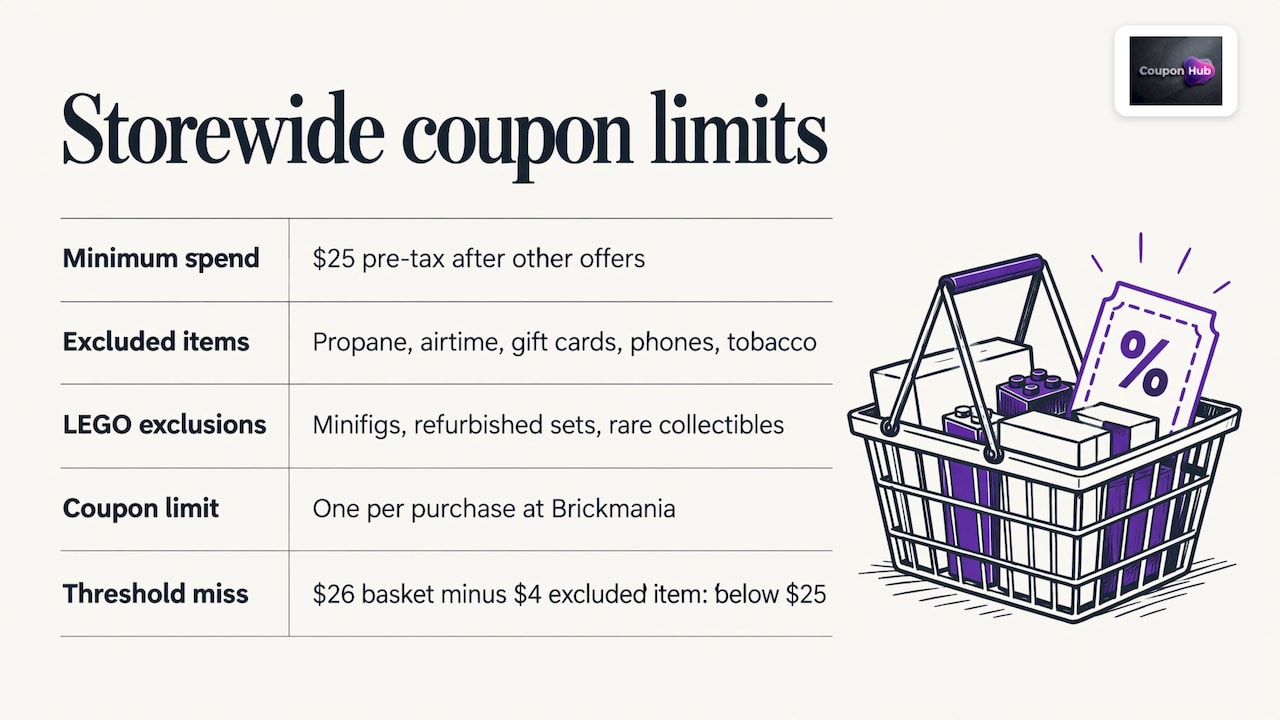
Family Dollar’s $5 off $25 coupon shows the pattern. It is accepted only when the pre-tax purchase price, after all other offers, is at least $25, and it excludes items such as propane, prepaid airtime, gift cards, cell phones and tobacco products. Brickmania, an online toy retailer, takes a similar approach: its storewide sales page lists which brands qualify, and LEGO sets qualify except minifigs, refurbished sets and rare collectibles. It also allows one coupon per purchase.
The gap between the headline and the threshold is where it stings. A “$5 off $25” coupon on a $26 basket that includes a $4 excluded item drops you below the line, and the code fails.
For a deeper look at how to read these limits, see our guide to coupon fine print and exclusions.
What a category coupon really covers
Category coupons depend on how the retailer sorts its catalog, not how you would sort it. A moisturizer might be “skin care” at one store and “beauty” at another. A kitchen gadget might sit under “home” or “small appliances.” The coupon follows the store’s labels.
Three habits help:
- Check the product page, not just the coupon. Many stores list eligible items or show a badge on qualifying products.
- Add the qualifying items first. Watch the discount line appear before you add anything else.
- Measure the threshold correctly. At Target, the category coupon threshold is based on the retail price of qualified items before item-level coupons are applied, which helps when you also have a smaller coupon on one product.
If you are unsure how stores group products, our explainer on coupon categories and what they mean walks through the common groupings.
Can you stack them?
Sometimes, and the rules are set store by store.
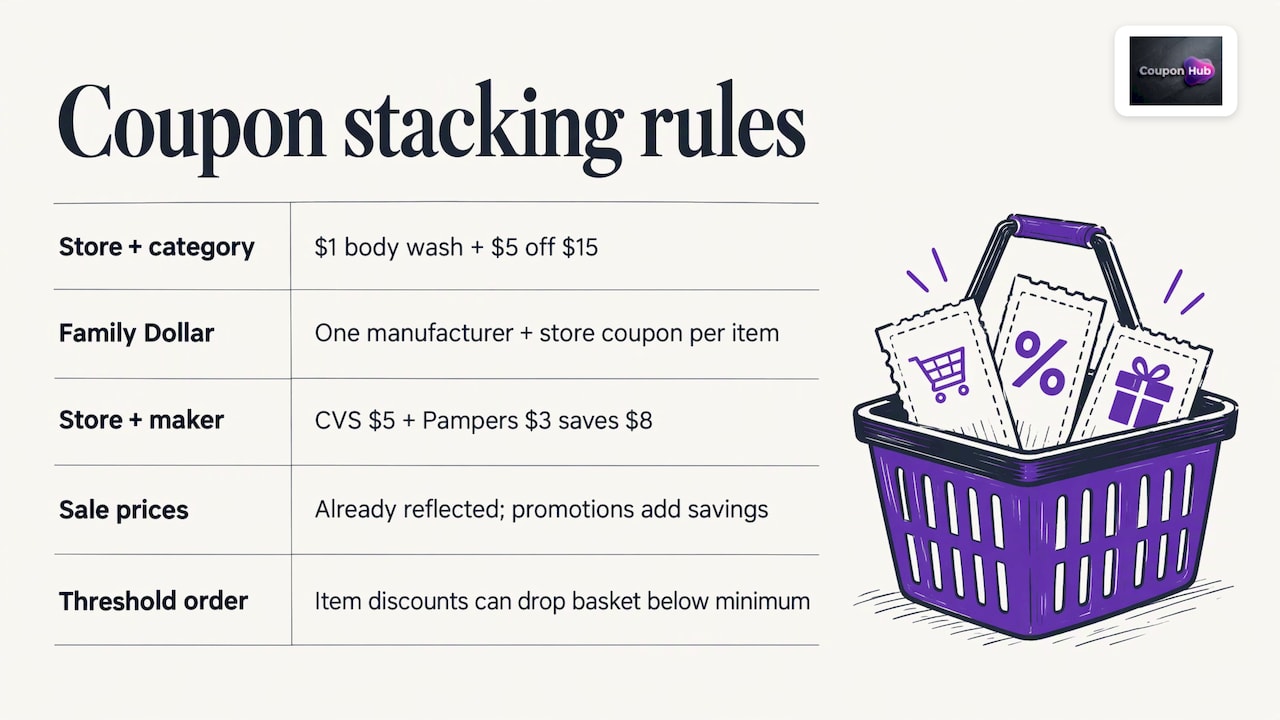
Storewide plus category. Target says you can use an item-level coupon alongside a category or storewide coupon, for example $1 off body wash with $5 off $15 of personal care. But, as noted above, only one storewide offer is allowed per transaction.
Storewide plus item coupons. Family Dollar allows one manufacturer coupon and one Family Dollar coupon per item. Its storewide offers apply after all other discounts, so if the basket falls under the threshold once item-level discounts are taken off, the storewide offer will not apply.
Store plus manufacturer. NerdWallet explains that a store coupon is issued by a specific retailer and usable only there, while a manufacturer coupon is issued by the product maker. Its example: a CVS $5 off $25 baby coupon plus a $3 Pampers manufacturer coupon saves $8 in total, though you should always check the retailer’s own stacking rules.
Sale prices. A sale price is not a coupon, and it does not always leave room for one. Macy’s explains that sale prices are already reflected in an item’s price, while promotions are additional savings. Not every sale item qualifies for a promotion, and final-sale items such as Last Act get no extra discounts.
The order matters. When a storewide threshold is measured after other discounts, stacking a category coupon first can push you under it. Run through the order in your cart before paying. Our guides on coupon stacking online and clearance and coupons cover how this plays out across stores.
How to compare two coupons before you pay
When you hold a storewide code and a category code for the same store, follow these steps:
- Write down the basket. List each item and its price.
- Mark what is excluded. Remove clearance, gift cards or any brand the terms name.
- Apply the storewide code. Calculate the discount on the eligible total and confirm the minimum is met after other discounts.
- Apply the category code. Calculate the discount on the qualifying items only.
- Compare the final totals, including tax and shipping. If the terms allow both, test the combined total as well.
A worked example
Your basket holds a $40 pair of sneakers, a $30 jacket and a $20 phone case, $90 in total, with no exclusions.
- Storewide code: 15% off everything. Savings: $13.50. Final: $76.50.
- Category code: 25% off shoes. Savings: $10. Final: $80.
The storewide code wins here. Change the basket to $100 of sneakers and $10 of accessories and the category code saves $25 against $16.50 for the storewide one. Same two coupons, different winner. That is why the headline percentage alone does not tell you much.
It also helps to compare value per unit. A coupon on a bigger package does not guarantee the lowest cost per unit. In one worked example, a $6.00 12-count package with a $1 coupon works out to $0.42 per unit, beating a $4.40 10-count store brand at $0.44.
Reasons a storewide or category code fails
Macy’s lists the usual causes: an excluded item or brand, an expired offer, a missed minimum purchase, an offer that cannot be combined, or one valid only through a specific channel. Add two more we see on checkout screens: a code limited to a region (see our note on regional restrictions) and one that cannot be used with an automatic discount.
Target’s terms add a few concrete ones: identical coupons are limited to four per household per day, expired coupons are not accepted, and Target Circle deals exclude clearance unless noted.
If a code fails, check the exclusions first, then the minimum, then the expiry date. Reading a store’s rules once saves repeated guesswork, and our guide to store coupon policies shows how.
Which one should you choose?
- Choose storewide when your basket spans several departments, when you are unsure what you will add, or when a percent-off code lets every eligible item benefit.
- Choose category when most of your spend sits in one department, especially if the percentage is clearly higher than the storewide offer.
- Choose whichever leaves the lower final total when you can only use one. The calculation takes a minute.
- Look for both when the store allows item-level coupons on top. Then even a modest category offer adds real savings.
Once you know a store’s rules, you start to see its sales cycles, and that makes it easier to buy when prices are lowest. That is the advice of NerdWallet contributor Jenny Martin, as reported in its couponing guide.
Where CouponHub fits
Our editors verify each promo code before it is published, including the store, the code’s validity and the discount details. Listings cover more than 3,000 online stores and can be sorted by store, category and recency, so you can tell at a glance whether an offer is storewide or tied to a category. You can start from the CouponHub home page, or browse a store such as Planetbeauty or Bernardo Fashions to see how terms appear next to each code.

If you want to find coupons for one retailer specifically, our guide on finding store coupons that work is a good next step, and the online couponing guide covers the full routine.
Our view
We think the most useful question about a coupon is never “how big is the number?” It is “what does this discount apply to, and what will I pay at the end?”
Storewide and category coupons answer that question differently, and a code is only as good as its terms. That is why we verify the store, the code’s validity and the discount details before a code appears on CouponHub, and why we keep the terms next to the code. A shopper should not have to find out at checkout that the offer excluded the one item in the basket.
Our catalog spans more than 3,000 stores and can be sorted by store, category and recency. Use it to line up a storewide offer and a category offer for the same retailer, do the quick final-price comparison above, and check out with the one that saves you the most.
CouponHub Team
FAQ
Can I use a storewide coupon and a category coupon on the same order?
It depends on the retailer. Target, for example, allows only one storewide offer per transaction and one category-level offer per item, and each offer must meet its own purchase requirement. Read the store’s coupon policy before you plan around combining them.
Does a storewide coupon apply to sale and clearance items?
Not always. Family Dollar accepts its coupons on sale or clearance items, while Target Circle deals exclude clearance unless noted and Macy’s says not all sale items qualify for extra promotions. The coupon’s terms will say which applies.
Does the minimum spend count before or after tax?
Usually before tax and after other discounts. Family Dollar’s $5 off $25 coupon requires at least $25 pre-tax after all other offers, so item-level discounts can pull you under the line.
Can I use a store coupon and a manufacturer coupon together?
Often, yes. NerdWallet’s example pairs a CVS $5 off $25 store coupon with a $3 Pampers manufacturer coupon for $8 saved. Check that retailer’s stacking rules first, since policies differ.
Sources
- Coupons & deals: Help, Target
- Article: Help, Target
- Family Dollar Coupon Policy
- Retail Storewide Sales, Brickmania
- Macy’s Offers, Discounts & Rewards
- Broad Promotions, Narrow Responses (Boughanmi, Iyengar, Park)
- Couponing for Beginners: 8 Tips for Getting Started, NerdWallet
- How to Use Coupons Without Overspending, Moneybucket